Blatant Homerism: Things are getting tight
We’ve reached a point in the college football season in which we usually know what teams are. This year, what we know is that teams are more similar than ever.
For instance, take a look at Bill Connelly’s SP+ rankings from 2022, which seems like the last season before the college football world truly started flattening out. At the end of the year, the Georgia Bulldogs claimed their second straight national championship by completing a dominant 15-0 run that earned UGA a 37.3 overall rating. In other words, SP+ projected that the Bulldogs were 37.3 points better than the average team, with a gap of 23 points between them and No. 25 Arkansas.
At this point in the 2026 season, SP+’s No. 1 team, Ohio State, has an overall rating of 28.6. That would make the Buckeyes about nine points weaker than the top team in ‘22. Moreover, the disparity between the squad at the top and the No. 25 Wake Forest Demon Deacons sits at 16.5 points – about a touchdown less than the difference in ‘22.
You’ll find plenty of the same names at or near the top of the heap in SP+ today as you would have in ‘22, such as UGA, Ohio State, Alabama and Texas. The distance between them and the rest of the field has shrunk, however.
In terms of play on the field, what does the compression in quality imply? Two things come to mind right off the bat.
First, overall team health probably matters more than ever. Compensation and relaxed restrictions on transfers have already combined to divide talent more equitably among schools, which is taxing depth at powerhouses that previously stockpiled elite prospects. Similarly, when the margins between teams are thinner, the absences of key players can have an outsized impact on those matchups.
The Oklahoma Sooners could offer a good test case here. With touted left tackle Michael Fasusi back in the lineup last week, their beleaguered offense looked smoother against an admittedly mediocre defense in Mississippi State. If the Sooners generate more productivity from their O down the stretch, it seems likely that Fasusi’s absence in the first half of the season played a larger role in OU’s inefficiency than we might typically project.
Second, we should get ready for a wild sprint to the finish of college football’s regular season.
In the SEC, half of the league’s members have power ratings implying point spreads of no more than a touchdown between them on a neutral field. Consider Kentucky: The Wildcats currently lead the standings in the SEC with a 5-1 record in conference games; however, they look like clear underdogs in two of their final three conference games, versus Tennessee in Knoxville and at Missouri. The line in the third game when Florida visits Lexington probably ends up around three points. It wouldn’t come as a surprise if UK caught an L in all three of those games, slipping closer to the middle of the pack at the end of the season.
Similarly, OU looks like a node for potential chaos down the stretch of the season. Of the Sooners’ five remaining conference games, all will probably have point spreads inside a touchdown either way. At this point, it feels unlikely that OU could work its way near the top of the SEC standings, but the Sooners could still impact the fates of contenders such as Ole Miss and Florida.
Oklahoma versus South Carolina: Containing the explosions
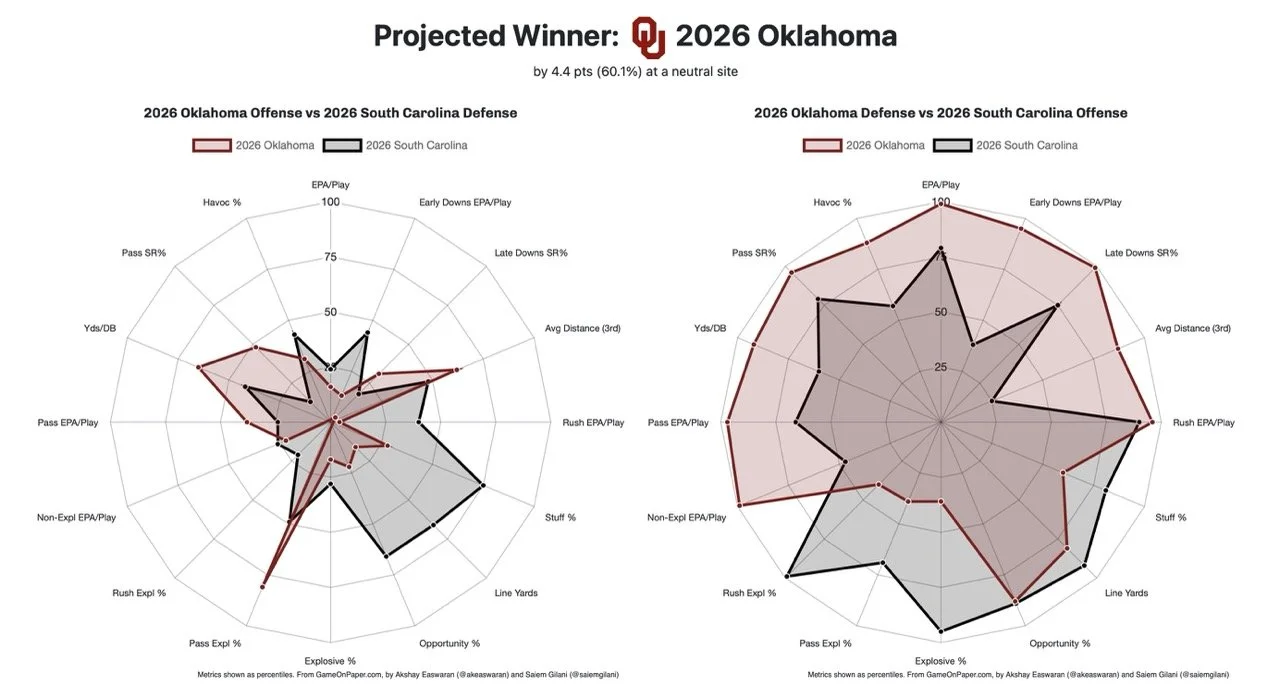
Description of matchup between Oklahoma and South Carolina via Game on Paper.
The graphic above from Game on Paper depicts the matchup this weekend between the Sooners and Gamecocks using a series of key success metrics. The bottom left of the two plots sums up the likely story of this game.
The Sooners don’t do much well on offense, but they do have a knack for cooking up explosive plays in the passing game. They rank in the 81st percentile nationally in explosive passing plays, which GoP defines as plays that generate more than 2.4 expected points added. (Expected points added, or EPA, quantifies the difference between the expected number of points a team can score on a play in a given scenario and what the team actually did on the play.) Conversely, the Gamecocks rank in the 49th percentile in explosive passing plays allowed.
When South Carolina has the ball, its explosive running game buoys an offense that ranks 95th nationally in explosive plays. For its part, the OU defense ranks in the 36th percentile in explosive plays. (The Sooners offset their tendency to allow big plays by erasing non-explosive plays and inducing a high percentage of negative plays in general.)
During the Gamecocks’ two-game winning streak, Tennessee’s EPA per dropback ranked in the 26th percentile, while Florida’s EPA per dropback ranked in the 47th percentile. In South Carolina’s three losses to Mississippi State, Alabama and Kentucky, the opposing offense’s EPA per dropback in the games ranked no worse than the 69th percentile.
If the OU passing game continues doing what it does, this should be a win for the Sooners.
Other games on my radar
A little blah this week, to be honest.
Florida vs. Georgia (in Atlanta)
UGA is the poster child for quality compression I mentioned earlier. The Bulldogs look like the best team in the country to me, but they’re nowhere close to the machines that churned out national titles a few years ago.
Northwestern at Oregon
Ducks junior quarterback Dylan Raiola is a fascinating mess. He gave an all-time bad performance in his first start of the year against UCLA, and things have only gotten marginally better since then. Even when throwing for 246 yards last week against a stank Illinois defense, he needed 41 attempts to get there.
Southern Miss at Louisiana-Monroe
One for the sickos. The fact that Southern Miss is a road favorite against anyone tells you how dire the situation has become for the Warhawks.
Ohio State at USC
In theory, this is one of those times when Lincoln Riley actually pulls through playing at home against a wounded blue blood. We’ll see what the bye week did for the Buckeyes in terms of triaging their QB situation.
Arizona at Texas Tech
Did you know the stadium in Lubbock is now known as Galaxy Stadium? No, it’s not a reference to the Space Jam cinematic universe. Tech sold the naming rights to a company that owns a data center nearby. How charming.