Blatant Homerism: Sooners' improvement could produce fewer wins
If you’re looking for an indication of just how surprising the Oklahoma Sooners’ 2025 season was, consider the consensus among prominent betting shops was to list their preseason win total at 6.5. At 10-2 in the regular season, OU eventually cleared that bar with ample room to spare.
The oddsmakers are apparently telling a more optimistic story about the Sooners a year later. FanDuel put OU’s preseason win total for 2026 at 7.5, juiced slightly to the under at -114. Even so, that total probably felt low to many people, given that we’re talking about a team that went to the College Football Playoff last season. For example, On3 pundits Andy Staples and Ari Wasserman characterized the projection as a slap in the face to the Sooners.
(Aside: You’ll often hear wishful thinkers dismiss the reliability of betting odds as projections because sportsbooks are trying to set lines that will generate even amounts of money on both sides of a wager. This is true in part, but they’re leaving out that oddsmakers do this by making accurate projections of the outcome of an event. If they were just throwing out point spreads based on lines they believe will generate an even split of money, they would lose their shirts to astute gamblers.)
You could take this news as a sign Vegas believes OU will have a worse team in 2026 than 2025. The Sooners won 10 games last year; now the oddsmakers are telling us they are likely to win seven or eight in the fall. What other message could they be sending?
However, if you compare the situation at this time one year ago to where things stand today, it looks as though Vegas is showing healthy respect for OU’s improvement over time.
For starters, relative to this time in 2025, it appears as though oddsmakers expect backsliding in the win-loss column this year across the SEC. Of the 16 teams in the conference, FanDuel has set the anchor at least a full game lower for seven of them this season. Note that OU is one of just five squads with a higher preseason win total this year.
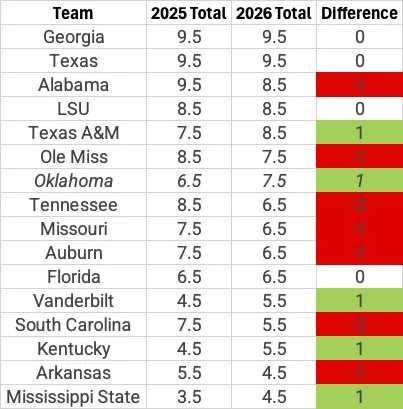
On net, the preseason projections suggest Vegas expects SEC teams to lose four more games this year versus what oddsmakers were expecting for the conference as a whole at this time in ‘25. It stands to reason that the change from eight conference games to nine this year would depress the total number of wins by SEC teams this season. Against that backdrop, it’s worth pointing out that OU actually gained a projected win this season over last.
And keep in mind the projected difficulty of the Sooners’ schedule looks roughly the same now as a year ago. They drew nine teams inside the top 25 of ESPN’s initial SP+ rankings for 2025. They get eight of the initial top 25 teams this season, and they’re replacing a game against a team like Kent State or Temple with another SEC opponent.
Of course, seeing as Vegas power ratings and the SP+ metrics have a tendency to converge, we could just use SP+ as a proxy for how linesmakers view OU. In the first batch of preseason SP+ numbers from ‘25, the Sooners checked in at No. 20 in the nation with an overall rating of 13.1. The first release for ‘26 finds them at No. 12 with an overall rating of 17.2, which implies a four-point spread year over year.
Again, it seems as though the computers – and oddsmakers, by extension – consider OU to be a program on the upswing. But having a stronger team doesn’t necessarily translate into a better record. The Sooners still have a brutal road ahead this fall.
If we were to extrapolate a little more, SP+ currently makes OU a clear underdog in two games – the Red River Shootout versus Texas and at Georgia. Additionally, SP+ currently indicates the Sooners are playing four tossups – at Michigan, Texas A&M, at Florida, and at Missouri. All in all, that works out to about four losses in those six games alone. OU would only need to slip up once in the remaining six games to hit the under.
I realize I’ve made this point repeatedly over time, but football is a wonky game that produces weird results. (That makes it fun.) Differences in context from one season to the next can yield win-loss records that obscure material improvement in a team’s performance.
In other words, don’t be shocked if we’re watching an improved OU squad in the fall that ends up with a worse record by a few games than last year’s team.